|
Reaction to the 2007
State
of the Union Address
The
following
graph indicates the average
change in skin conductance response of a panel of 15 women
and
15 men (10 Republicans, 10 Democrats,
and 10 Independents ranging in age
from 23 to
66) to President George W. Bush's 2007 State of the Union Address. Participants
watched a videotaped copy of the address as their responses were automatically
recorded. The graph
shows the average combined change per minute from participant baseline scores
in
micro-siemens.
The higher the score, the greater the engagement with the speech. These results
cannot be projected
to any other group beyond the participants. 
Key points of engagement/disengagement in the address:
-
The first 3 minutes of
the
2007 address was more engaging than the 2006 address.
-
Republicans had higher
levels of engagement in the first 20 minutes of the address and then had the same levels
of engagement as Democrats and Independents for the remainder of the address.
-
Levels of engagement
began to decrease after 20 minutes and did not start to increase again until the 31st minute
("Every one of us wishes this war were over and won.").
-
Engagement dropped again
and did not increase until the 44th minute of the address
when Dikembe Mutombo was introduced.
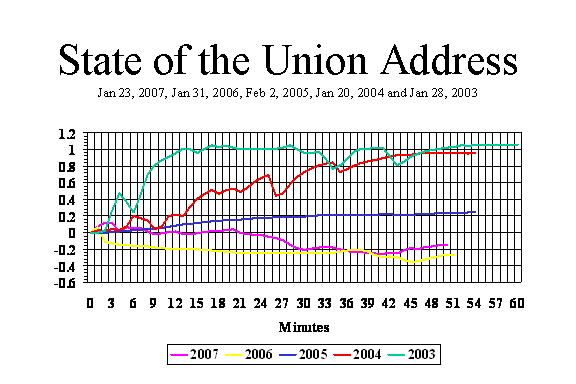
The following
graph compares
average
responses from the 2007 address to the average responses for
Mr. Bush's 2003, 2004, 2005, and 2006 addresses.
Transcript with minute markers: State of the Union Address by President George W. Bush
January 23, 2007
United States
Capitol
Washington, D.C.
9:13 P.M. EST
THE PRESIDENT: Thank you very much.
And tonight, I have a high privilege and distinct honor of my own -- as the first President
to begin the State of the Union message with these words: Madam Speaker. (Applause.)
In his day, the late Congressman
Thomas D'Alesandro, Jr. from Baltimore, Maryland, saw Presidents Roosevelt and Truman at this
rostrum. But nothing could compare with the sight of his only daughter, Nancy, presiding tonight
as Speaker of the House
MINUTE 1
of Representatives. (Applause.)
Congratulations, Madam Speaker. (Applause.)
Two members of the House and Senate
are not with us tonight, and we pray for the recovery and speedy return of Senator Tim Johnson
and Congressman Charlie Norwood. (Applause.)
Madam Speaker, Vice President Cheney,
members of Congress, distinguished guests, and fellow citizens:
MINUTE 2
The rite of custom brings us together
at a defining hour -- when decisions are hard and courage is needed. We enter the year 2007
with large endeavors underway, and others that are ours to begin. In all of this, much is asked
of us. We must have the will to face difficult challenges and determined enemies -- and the
wisdom to face them together.
Some in this chamber are new to
the House and the Senate -- and I congratulate the Democrat majority. (Applause.) Congress
has changed, but not our responsibilities. Each of us is guided by our own convictions -- and
to these we must stay faithful. Yet we're all held to the same standards, and called to serve
the same good purposes: To extend this nation's prosperity;
MINUTE 3
to spend the people's money wisely;
to solve problems, not leave them to future generations; to guard America against all evil;
and to keep faith with those we have sent forth to defend us. (Applause.)
We're not the first to come here
with a government divided and uncertainty in the air. Like many before us, we can work through
our differences, and we can achieve big things for the American people. Our citizens don't
much care which side of the aisle we sit on -- as long as we're willing to cross that aisle
when there is work to be done. (Applause.) Our job is to make life better for our fellow Americans,
and to help them to build a future of hope and opportunity -- and this is the business before
us tonight.
MINUTE 4
A future of hope and opportunity
begins with a growing economy -- and that is what we have. We're now in the 41st month of uninterrupted
job growth, a recovery that has created 7.2 million new jobs -- so far. Unemployment is low,
inflation is low, wages are rising. This economy is on the move, and our job is to keep it
that way, not with more government, but with more enterprise. (Applause.)
Next week,
I'll deliver a full report on the state of our economy. Tonight, I want to discuss three economic
reforms that deserve to be priorities for this Congress.
First, we must balance the federal
budget. (Applause.)
MINUTE 5
We can do so without raising taxes.
(Applause.) What we need is impose spending discipline in Washington, D.C. We set a goal of
cutting the deficit in half by 2009, and met that goal three years ahead of schedule. (Applause.)
Now let us take the next step. In the coming weeks, I will submit a budget that eliminates
the federal deficit within the next five years. (Applause.) I ask you to make the same commitment.
Together,
MINUTE 6
we can restrain the spending appetite
of the federal government, and we can balance the federal budget. (Applause.)
Next, there is the matter of earmarks.
These special interest items are often slipped into bills at the last hour -- when not even
C-SPAN is watching. (Laughter.) In 2005 alone, the number of earmarks grew to over 13,000 and
totaled nearly $18 billion. Even worse, over 90 percent of earmarks never make it to the floor
of the House and Senate -- they are dropped into committee reports that are not even part of
the bill that arrives on my desk. You didn't vote them into law. I didn't sign them into law.
Yet, they're treated as if they have the force of law. The time has come to end this practice.
So let us work together to reform the budget process, expose every earmark to the light of
day and to a vote in Congress, and cut
MINUTE 7
the number and cost of earmarks
at least in half by the end of this session. (Applause.)
And, finally, to keep this economy
strong we must take on the challenge of entitlements. Social Security and Medicare and Medicaid
are commitments of conscience, and so it is our duty to keep them permanently sound. Yet, we're
failing in that duty. And this failure will one day leave our children with three bad options:
huge tax increases, huge deficits, or huge and immediate cuts in benefits. Everyone in this
chamber knows this to be true -- yet somehow we have not found it in ourselves to act. So let
us work together and do it now. With enough good sense and goodwill, you and I
MINUTE 8
can fix Medicare and Medicaid --
and save Social Security. (Applause.)
Spreading opportunity and hope
in America also requires public schools that give children the knowledge and character they
need in life. Five years ago, we rose above partisan differences to pass the No Child Left
Behind Act, preserving local control, raising standards, and holding those schools accountable
for results. And because we acted, students are performing better in reading and math, and
minority students are closing the achievement gap.
Now the task is to build on the
success, without watering down standards, without taking control from local communities, and
without backsliding and calling it reform. We can lift student achievement even higher by giving
local leaders flexibility
MINUTE 9
to turn around failing schools,
and by giving families with children stuck in failing schools the right to choose someplace
better. (Applause.) We must increase funds for students who struggle -- and make sure these
children get the special help they need. (Applause.) And we can make sure our children are
prepared for the jobs of the future and our country is more competitive by strengthening math
and science skills. The No Child Left Behind Act has worked for America's children -- and I
ask Congress to reauthorize this good law. (Applause.)
A future of hope and opportunity
requires that all our citizens have affordable and available health care. (Applause.)
MINUTE 10
When it comes to health care, government
has an obligation to care for the elderly, the disabled, and poor children. And we will meet
those responsibilities. For all other Americans, private health insurance is the best way to
meet their needs. (Applause.) But many Americans cannot afford a health insurance policy.
And so tonight, I propose two new
initiatives to help more Americans afford their own insurance. First, I propose a standard
tax deduction for health insurance that will be like the standard tax deduction for dependents.
Families with health insurance will pay no income on
MINUTE 11
payroll tax -- or payroll taxes
on $15,000 of their income. Single Americans with health insurance will pay no income or payroll
taxes on $7,500 of their income. With this reform, more than 100 million men, women, and children
who are now covered by employer-provided insurance will benefit from lower tax bills. At the
same time, this reform will level the playing field for those who do not get health insurance
through their job. For Americans who now purchase health insurance on their own, this proposal
would mean a substantial tax savings -- $4,500 for a family of four making $60,000 a year.
And for the millions of other Americans who have no health insurance at all, this deduction
would help put a basic private health insurance plan within their reach. Changing the tax code
is a vital and necessary step to making health care
MINUTE 12
affordable for more Americans.
(Applause.)
My second proposal is to help the
states that are coming up with innovative ways to cover the uninsured. States that make basic
private health insurance available to all their citizens should receive federal funds to help
them provide this coverage to the poor and the sick. I have asked the Secretary of Health and
Human Services to work with Congress to take existing federal funds and use them to create
"Affordable Choices" grants. These grants would give our nation's governors more
money and more flexibility to get private health insurance to those most in need.
There are many other ways that
Congress can help. We need to expand Health Savings Accounts. (Applause.)
MINUTE 13
We need to help small businesses
through Association Health Plans. (Applause.) We need to reduce costs and medical errors with
better information technology. (Applause.) We will encourage price transparency. And to protect
good doctors from junk lawsuits, we need to pass medical liability reform. (Applause.) In all
we do, we must remember that the best health care decisions are made not by government and
insurance companies, but by patients and their doctors. (Applause.)
MINUTE 14
Extending hope and opportunity
in our country requires an immigration system worthy of America -- with laws that are fair
and borders that are secure. When laws and borders are routinely violated, this harms the interests
of our country. To secure our border, we're doubling the size of the Border Patrol, and funding
new infrastructure and technology.
Yet even with all these steps,
we cannot fully secure the border unless we take pressure off the border -- and that requires
a temporary worker program. We should establish a legal and orderly path for foreign workers
to enter our country to work on a temporary basis. As a result, they won't have to try to sneak
in, and that will leave Border Agents free to chase down drug smugglers
MINUTE 15
and criminals and terrorists. (Applause.)
We'll enforce our immigration laws at the work site and give employers the tools to verify
the legal status of their workers, so there's no excuse left for violating the law. (Applause.)
We need to uphold the great tradition
of the melting pot that welcomes and assimilates new arrivals. (Applause.) We need to resolve
the status of the illegal immigrants who are already in our country without animosity and without
amnesty. (Applause.) Convictions run deep in this Capitol when
MINUTE 16
it comes to immigration. Let us
have a serious, civil, and conclusive debate, so that you can pass, and I can sign, comprehensive
immigration reform into law. (Applause.)
Extending hope and opportunity
depends on a stable supply of energy that keeps America's economy running and America's environment
clean. For too long our nation has been dependent on foreign oil. And this dependence leaves
us more vulnerable to hostile regimes, and to terrorists -- who could cause huge disruptions
of oil shipments, and raise the price of oil, and do great harm to our economy.
It's in our vital interest to diversify
America's energy supply -- the way forward is through technology.
MINUTE 17
We must continue changing the way
America generates electric power, by even greater use of clean coal technology, solar and wind
energy, and clean, safe nuclear power. (Applause.) We need to press on with battery research
for plug-in and hybrid vehicles, and expand the use of clean diesel vehicles and biodiesel
fuel. (Applause.) We must continue investing in new methods of producing ethanol -- (applause)
-- using everything from wood chips to grasses, to agricultural wastes.
We made a
lot of progress, thanks to good policies here in Washington and the strong response of the
market. And now even more dramatic advances
MINUTE 18
are within reach. Tonight, I ask
Congress to join me in pursuing a great goal. Let us build on the work we've done and reduce
gasoline usage in the United States by 20 percent in the next 10 years. (Applause.) When we
do that we will have cut our total imports by the equivalent of three-quarters of all the oil
we now import from the Middle East.
To reach this goal, we must increase
the supply of alternative fuels, by setting a mandatory fuels standard to require 35 billion
gallons of renewable and alternative fuels in 2017 -- and that is nearly five times the current
target. (Applause.)
MINUTE 19
At the same time, we need to reform
and modernize fuel economy standards for cars the way we did for light trucks -- and conserve
up to 8.5 billion more gallons of gasoline by 2017.
Achieving these ambitious goals
will dramatically reduce our dependence on foreign oil, but it's not going to eliminate it.
And so as we continue to diversify our fuel supply, we must step up domestic oil production
in environmentally sensitive ways. (Applause.) And to further protect America against severe
disruptions to our oil supply, I ask Congress to double the current capacity of the Strategic
Petroleum Reserve. (Applause.)
America is on the verge of technological
breakthroughs that will enable us to live our lives less dependent on oil. And these technologies
will help us be better stewards of the environment,
MINUTE 20
and they will help us to confront
the serious challenge of global climate change. (Applause.)
A future of hope and opportunity
requires a fair, impartial system of justice. The lives of our citizens across our nation are
affected by the outcome of cases pending in our federal courts. We have a shared obligation
to ensure that the federal courts have enough judges to hear those cases and deliver timely
rulings. As President, I have a duty to nominate qualified men and women to vacancies on the
federal bench. And the United States Senate has a duty, as well, to give those nominees a fair
hearing,
MINUTE 21
and a prompt up-or-down vote on
the Senate floor. (Applause.)
For all of us in this room, there
is no higher responsibility than to protect the people of this country from danger. Five years
have come and gone since we saw the scenes and felt the sorrow that the terrorists can cause.
We've had time to take stock of our situation. We've added many critical protections to guard
the homeland. We know with certainty that the horrors of that September morning were just a
glimpse of what the terrorists intend for us -- unless we stop them.
With the distance of time, we find
ourselves debating the causes of conflict and the course we have followed. Such debates are
essential when a great democracy faces
MINUTE 22
great questions. Yet one question
has surely been settled: that to win the war on terror we must take the fight to the enemy.
(Applause.)
From the start, America and our
allies have protected our people by staying on the offense. The enemy knows that the days of
comfortable sanctuary, easy movement, steady financing, and free flowing communications are
long over. For the terrorists, life since 9/11 has never been the same.
Our success
in this war is often measured by the things that did not happen. We cannot know the full extent
of the attacks that we and our allies have prevented, but here is some of what
MINUTE 23
we do know: We stopped an al Qaeda
plot to fly a hijacked airplane into the tallest building on the West Coast. We broke up a
Southeast Asian terror cell grooming operatives for attacks inside the United States. We uncovered
an al Qaeda cell developing anthrax to be used in attacks against America. And just last August,
British authorities uncovered a plot to blow up passenger planes bound for America over the
Atlantic Ocean. For each life saved, we owe a debt of gratitude to the brave public servants
who devote their lives to finding the terrorists and stopping them. (Applause.)
MINUTE 24
Every success against the terrorists
is a reminder of the shoreless ambitions of this enemy. The evil that inspired and rejoiced
in 9/11 is still at work in the world. And so long as that's the case, America is still a nation
at war.
In the mind of the terrorist, this
war began well before September the 11th, and will not end until their radical vision is fulfilled.
And these past five years have given us a much clearer view of the nature of this enemy. Al
Qaeda and its followers are Sunni extremists, possessed by hatred and commanded by a harsh
and narrow ideology. Take almost any principle of civilization, and their goal is the opposite.
They preach with threats, instruct with bullets and bombs, and promise paradise for the murder
of the innocent.
Our enemies
MINUTE 25
are quite explicit about their
intentions. They want to overthrow moderate governments, and establish safe havens from which
to plan and carry out new attacks on our country. By killing and terrorizing Americans, they
want to force our country to retreat from the world and abandon the cause of liberty. They
would then be free to impose their will and spread their totalitarian ideology. Listen to this
warning from the late terrorist Zarqawi: "We will sacrifice our blood and bodies to put
an end to your dreams, and what is coming is even worse." Osama bin Laden declared: "Death
is better than living on this Earth with the unbelievers among us."
These men are not given to idle
words, and they are just one camp in the Islamist radical movement. In recent times, it has
also become clear that we face an escalating danger from Shia extremists who are just as hostile
to America, and are also determined to dominate the Middle East.
MINUTE 26
Many are known to take direction
from the regime in Iran, which is funding and arming terrorists like Hezbollah -- a group second
only to al Qaeda in the American lives it has taken.
The Shia and Sunni extremists are
different faces of the same totalitarian threat. Whatever slogans they chant, when they slaughter
the innocent they have the same wicked purposes. They want to kill Americans, kill democracy
in the Middle East, and gain the weapons to kill on an even more horrific scale.
In the sixth year since our nation
was attacked, I wish I could report to you that the dangers had ended. They have not. And so
it remains the policy of this government to use every lawful and proper tool of intelligence,
diplomacy, law enforcement, and military action to do our duty, to find these enemies, and
to protect the American people. (Applause.)
MINUTE 27
This war is more than a clash of
arms -- it is a decisive ideological struggle, and the security of our nation is in the balance.
To prevail, we must remove the conditions that inspire blind hatred, and drove 19 men to get
onto airplanes and to come and kill us. What every terrorist fears most is human freedom --
societies where men and women make their own choices, answer to their own conscience, and live
by their hopes instead of their resentments. Free people are not drawn to violent and malignant
ideologies -- and most will choose a better way when they're given a chance.
MINUTE 28
So we advance our own security
interests by helping moderates and reformers and brave voices for democracy. The great question
of our day is whether America will help men and women in the Middle East to build free societies
and share in the rights of all humanity. And I say, for the sake of our own security, we must.
(Applause.)
In the last two years, we've seen
the desire for liberty in the broader Middle East -- and we have been sobered by the enemy's
fierce reaction. In 2005, the world watched as the citizens of Lebanon raised the banner of
the Cedar Revolution, they drove out the Syrian occupiers and chose new leaders in free elections.
MINUTE 29
In 2005, the people of Afghanistan
defied the terrorists and elected a democratic legislature. And in 2005, the Iraqi people held
three national elections, choosing a transitional government, adopting the most progressive,
democratic constitution in the Arab world, and then electing a government under that constitution.
Despite endless threats from the killers in their midst, nearly 12 million Iraqi citizens came
out to vote in a show of hope and solidarity that we should never forget. (Applause.)
A
thinking enemy watched all of these scenes, adjusted their tactics, and in 2006 they struck
back. In Lebanon, assassins took the life of Pierre Gemayel, a prominent participant in the
Cedar Revolution. Hezbollah terrorists,
MINUTE 30
with support from Syria and Iran,
sowed conflict in the region and are seeking to undermine Lebanon's legitimately elected government.
In Afghanistan, Taliban and al Qaeda fighters tried to regain power by regrouping and engaging
Afghan and NATO forces. In Iraq, al Qaeda and other Sunni extremists blew up one of the most
sacred places in Shia Islam -- the Golden Mosque of Samarra. This atrocity, directed at a Muslim
house of prayer, was designed to provoke retaliation from Iraqi Shia -- and it succeeded. Radical
Shia elements, some of whom receive support from Iran, formed death squads. The result was
a tragic escalation of sectarian rage and reprisal that continues to this day.
This is not the fight we entered
in Iraq, but it is the fight we're in. Every one of us wishes this war were over and won. Yet
it
MINUTE 31
would not be like us to leave our
promises unkept, our friends abandoned, and our own security at risk. (Applause.) Ladies and
gentlemen: On this day, at this hour, it is still within our power to shape the outcome of
this battle. Let us find our resolve, and turn events toward victory. (Applause.)
We're
carrying out a new strategy in Iraq -- a plan that demands more from Iraq's elected government,
and gives our forces in Iraq the reinforcements they need to complete their mission.
MINUTE 32
Our goal is a democratic Iraq that
upholds the rule of law, respects the rights of its people, provides them security, and is
an ally in the war on terror.
In order to make progress toward
this goal, the Iraqi government must stop the sectarian violence in its capital. But the Iraqis
are not yet ready to do this on their own. So we're deploying reinforcements of more than 20,000
additional soldiers and Marines to Iraq. The vast majority will go to Baghdad, where they will
help Iraqi forces to clear and secure neighborhoods, and serve as advisers embedded in Iraqi
Army units. With Iraqis in the lead, our forces will help secure the city by chasing down the
terrorists, insurgents, and the roaming death squads. And in Anbar Province, where al Qaeda
terrorists have gathered and local forces have begun showing a willingness to fight them, we're
sending an additional 4,000 United States Marines, with orders to find the terrorists
MINUTE 33
and clear them out. (Applause.)
We didn't drive al Qaeda out of their safe haven in Afghanistan only to let them set up a new
safe haven in a free Iraq.
The people of Iraq want to live
in peace, and now it's time for their government to act. Iraq's leaders know that our commitment
is not open-ended. They have promised to deploy more of their own troops to secure Baghdad
-- and they must do so. They pledged that they will confront violent radicals of any faction
or political party -- and they need to follow through, and lift needless restrictions on Iraqi
and coalition forces, so these troops can achieve their mission of bringing security to all
of the people
MINUTE 34
of Baghdad. Iraq's leaders have
committed themselves to a series of benchmarks -- to achieve reconciliation, to share oil revenues
among all of Iraq's citizens, to put the wealth of Iraq into the rebuilding of Iraq, to allow
more Iraqis to re-enter their nation's civic life, to hold local elections, and to take responsibility
for security in every Iraqi province. But for all of this to happen, Baghdad must be secure.
And our plan will help the Iraqi government take back its capital and make good on its commitments.
My fellow citizens, our military
commanders and I have carefully weighed the options. We discussed every possible approach.
In the end, I chose this course of action because it provides the best chance for success.
Many in this chamber understand that America must not fail in Iraq, because you understand
that the consequences of failure would be grievous and
MINUTE 35
far-reaching.
If American forces step back before
Baghdad is secure, the Iraqi government would be overrun by extremists on all sides. We could
expect an epic battle between Shia extremists backed by Iran, and Sunni extremists aided by
al Qaeda and supporters of the old regime. A contagion of violence could spill out across the
country -- and in time, the entire region could be drawn into the conflict.
For America,
this is a nightmare scenario. For the enemy, this is the objective. Chaos is the greatest ally
-- their greatest ally in this struggle. And out of chaos in Iraq would emerge an emboldened
enemy with new safe havens, new recruits, new resources, and an even greater determination
to harm America. To allow this to happen would be to ignore the lessons of September the 11th
and
MINUTE 36
invite tragedy. Ladies and gentlemen,
nothing is more important at this moment in our history than for America to succeed in the
Middle East, to succeed in Iraq and to spare the American people from this danger. (Applause.)
This is where matters stand tonight,
in the here and now. I have spoken with many of you in person. I respect you and the arguments
you've made. We went into this largely united, in our assumptions and in our convictions. And
whatever you voted for, you did not vote for failure. Our country is pursuing a new strategy
in Iraq, and I
MINUTE 37
ask you to give it a chance to
work. And I ask you to support our troops in the field, and those on their way. (Applause.)
The war on terror we fight today
is a generational struggle that will continue long after you and I have turned our duties over
to others. And that's why it's important to work together so our nation can see this great
effort through. Both parties and both branches should work in close consultation. It's why
I propose to establish a special advisory council on the war on terror, made up of leaders
in Congress from both political parties. We will share
MINUTE 38
ideas for how to position America
to meet every challenge that confronts us. We'll show our enemies abroad that we are united
in the goal of victory.
And one of the first steps we can
take together is to add to the ranks of our military so that the American Armed Forces are
ready for all the challenges ahead. (Applause.) Tonight I ask the Congress to authorize an
increase in the size of our active Army and Marine Corps by 92,000 in the next five years.
(Applause.) A second task we can take on together is to design and establish a volunteer Civilian
Reserve Corps. Such a corps would function much like our military reserve. It would ease the
MINUTE 39
burden on the Armed Forces by allowing
us to hire civilians with critical skills to serve on missions abroad when America needs them.
It would give people across America who do not wear the uniform a chance to serve in the defining
struggle of our time.
Americans can have confidence in
the outcome of this struggle because we're not in this struggle alone. We have a diplomatic
strategy that is rallying the world to join in the fight against extremism. In Iraq, multinational
forces are operating under a mandate from the United Nations. We're working with Jordan and
Saudi Arabia and Egypt and the Gulf States to increase support for Iraq's government.
The United Nations has imposed
sanctions on Iran, and made it clear that the world will not allow the regime in Tehran to
acquire nuclear weapons. (Applause.)
MINUTE 40
With the other members of the Quartet
-- the U.N., the European Union, and Russia -- we're pursuing diplomacy to help bring peace
to the Holy Land, and pursuing the establishment of a democratic Palestinian state living side-by-side
with Israel in peace and security. (Applause.) In Afghanistan, NATO has taken the lead in turning
back the Taliban and al Qaeda offensive -- the first time the Alliance has deployed forces
outside the North Atlantic area. Together with our partners in China, Japan, Russia, and South
Korea, we're pursuing intensive diplomacy to achieve a Korean Peninsula free of nuclear weapons.
(Applause.)
We will continue to speak out for
the cause of freedom in places like Cuba, Belarus, and Burma - and
MINUTE 41
continue to awaken the conscience
of the world to save the people of Darfur. (Applause.)
American foreign policy is
more than a matter of war and diplomacy. Our work in the world is also based on a timeless
truth: To whom much is given, much is required. We hear the call to take on the challenges
of hunger and poverty and disease -- and that is precisely what America is doing. We must continue
to fight HIV/AIDS, especially on the continent of Africa. (Applause.)
MINUTE 42
Because you funded our Emergency
Plan for AIDS Relief, the number of people receiving life-saving drugs has grown from 50,000
to more than 800,000 in three short years. I ask you to continue funding our efforts to fight
HIV/AIDS. I ask you to provide $1.2 billion over five years so we can combat malaria in 15
African countries. (Applause.)
I ask that you fund the Millennium
Challenge Account, so that American aid reaches the people who need it, in nations where democracy
is on the rise and corruption is in retreat. And let us continue to support the expanded trade
and debt relief that are the best hope for lifting lives and
MINUTE 43
eliminating poverty. (Applause.)
When America serves others in this
way, we show the strength and generosity of our country. These deeds reflect the character
of our people. The greatest strength we have is the heroic kindness, courage, and self-sacrifice
of the American people. You see this spirit often if you know where to look -- and tonight
we need only look above to the gallery.
Dikembe Mutombo grew up in Africa,
amid great poverty and disease. He came to Georgetown University on a scholarship to study
medicine -- but Coach John Thompson got a look at Dikembe and had a different idea. (Laughter.)
Dikembe became a star in the NBA, and a citizen of the United States. But he
MINUTE 44
never forgot the land of his birth,
or the duty to share his blessings with others. He built a brand new hospital in his old hometown.
A friend has said of this good-hearted man: "Mutombo believes that God has given him this
opportunity to do great things." And we are proud to call this son of the Congo a citizen
of the United States of America. (Applause.)
After her daughter was born, Julie
Aigner-Clark searched for ways to share her love of music and art with her child. So she borrowed
some
MINUTE 45
equipment, and began filming children's
videos in her basement. The Baby Einstein Company was born, and in just five years her business
grew to more than $20 million in sales. In November 2001, Julie sold Baby Einstein to the Walt
Disney Company, and with her help Baby Einstein has grown into a $200 million business. Julie
represents the great enterprising spirit of America. And she is using her success to help others
-- producing child safety videos with John Walsh of the National Center for Missing and Exploited
Children. Julie says of her new project: "I believe it's the most important thing that
I have ever done. I believe that children have the right to live in a world that is safe."
And so tonight, we are pleased to welcome this talented business entrepreneur and generous
social entrepreneur -- Julie Aigner-Clark. (Applause.)
MINUTE 46
Three weeks ago, Wesley Autrey
was waiting at a Harlem subway station with his two little girls, when he saw a man fall into
the path of a train. With seconds to act, Wesley jumped onto the tracks, pulled the man into
the space between the rails, and held him as the train passed right above their heads. He insists
he's not a hero. He says: "We got guys and girls overseas dying for us to have our freedoms.
We have got to show each other some love." There is something wonderful about a country
that produces a brave and humble man like Wesley Autrey. (Applause.)
MINUTE 47
Tommy Rieman was a teenager pumping
gas in Independence, Kentucky, when he enlisted in the United States Army. In December 2003,
he was on a reconnaissance mission in Iraq when his team came under heavy enemy fire. From
his Humvee, Sergeant Rieman returned fire; he used his body as a shield to protect his gunner.
He was shot in the chest and arm, and received shrapnel wounds to his legs
MINUTE 48
-- yet he refused medical attention,
and stayed in the fight. He helped to repel a second attack, firing grenades at the enemy's
position. For his exceptional courage, Sergeant Rieman was awarded the Silver Star. And like
so many other Americans who have volunteered to defend us, he has earned the respect and the
gratitude of our entire country. (Applause.)
In such courage and compassion,
ladies
MINUTE 49
and gentlemen, we see the spirit
and character of America -- and these qualities are not in short supply. This is a decent and
honorable country -- and resilient, too. We've been through a lot together. We've met challenges
and faced dangers, and we know that more lie ahead. Yet we can go forward with confidence --
because the State of our Union is strong, our cause in the world is right, and tonight that
cause goes on. God bless. (Applause.)
(See you next year. Thank you for
your prayers.)
|